

Proven Golf Swing Tips That Will Fix Your Ball Flight
Most golf swing tips treat symptoms instead of causes. Learn how to read your ball flight, diagnose the real fault behind a slice, hook, or thin and fat shot, and fix it at the source with proven, targeted swing changes.
Search for golf swing tips and you will drown in advice within seconds. Keep your head down. Swing slower. Turn your hips. Some of it helps. Most of it treats symptoms while ignoring the cause, which is why so many golfers collect tips for years and never actually change their ball flight.
This guide takes a different angle. Instead of a random pile of cues, we look at what your ball flight is telling you and give you the small number of changes that fix each fault at the source.
Quick Answer
Your ball flight is a report card on your swing. A slice usually means the clubface is open relative to your swing path. A hook means it is closed. Thin and fat contact usually trace back to a low point that is in the wrong place. Fix the face and the low point, and the vast majority of bad shots clean up on their own, without a single swing thought about your head.
Read Your Ball Flight First
Before you change anything, watch where the ball goes. Your misses are data, not embarrassment.
If the ball starts fairly straight then curves hard to the right for a right handed golfer, that is a slice, and it is the most common miss in recreational golf. If it curves hard left, that is a hook. If you catch the ground before the ball, that is fat. If you catch the top half of the ball and it scuttles low, that is thin.

Each of these has a specific cause, and chasing the wrong fix is how golfers waste entire seasons. This same principle of diagnosing before acting is exactly why we wrote up the seven swing mistakes that quietly destroy your game. Reading that alongside this guide gives you a full picture of what is really going wrong.
Fixing the Slice
The slice is almost always a clubface problem. At impact the face is pointing right of your swing path, and that open face puts sidespin on the ball.
The most common hidden cause is a weak grip, meaning your hands are rotated too far toward the target. Turn both hands slightly away from the target on the grip so you can see two or three knuckles on your lead hand when you look down. This one change lets the face square up naturally through impact.
If your grip is fine, the culprit is often a grip that is physically too thick for your hands, which stops your wrists from releasing. That is one of the practical reasons a club fitting can quietly transform a golfer who has fought a slice for years.
Fixing the Hook
A hook is the mirror image. The face is closed to the path, so the ball dives left. Usually the grip has drifted too strong, with the hands rotated too far away from the target.
Ease the hands back toward a neutral position so you see two knuckles rather than three or four. Then feel like your body keeps turning through the shot rather than stalling and letting your hands flip the face shut. A body that keeps rotating gives the hands less chance to slam the face closed.
Fixing Fat and Thin Contact
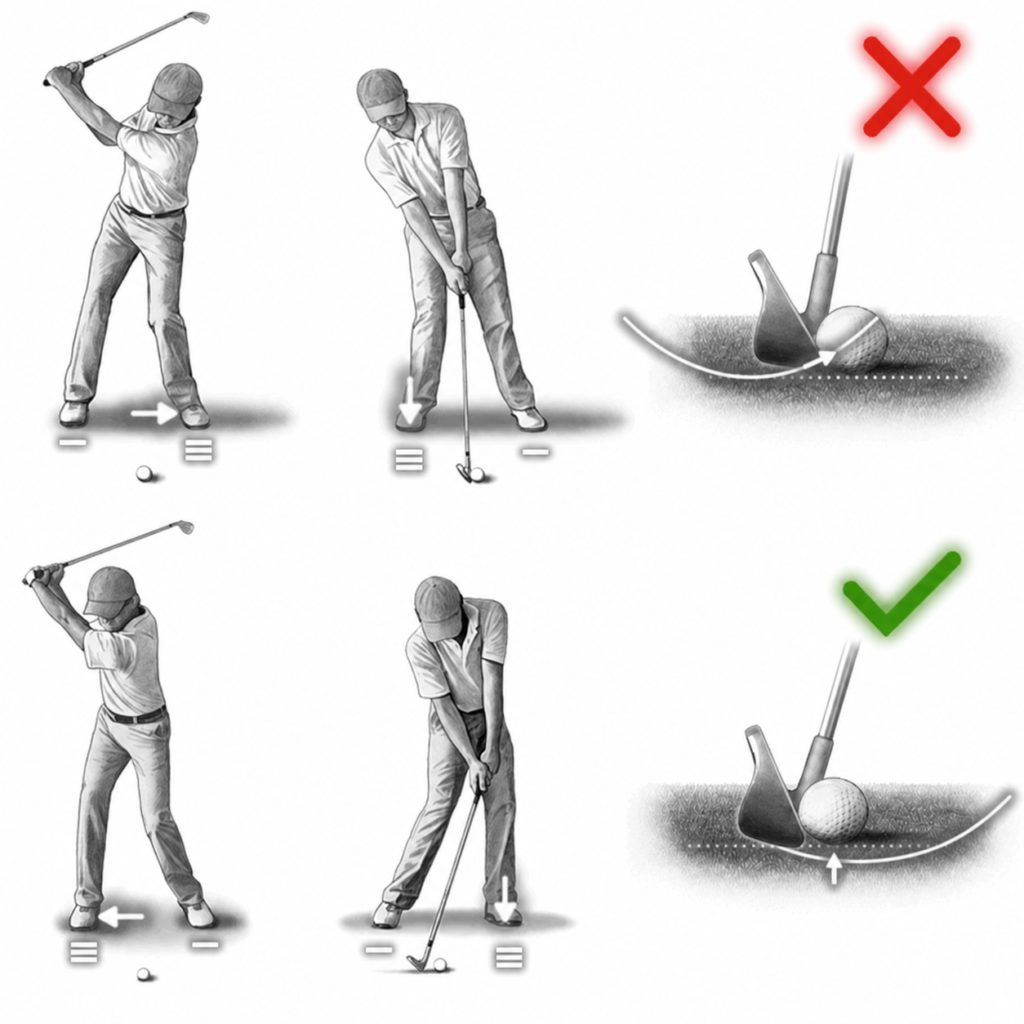
Fat and thin shots are two sides of the same coin. They are low point problems. In a good iron swing, the lowest point of the arc happens just after the ball, which is why good players take a divot in front of where the ball was.
If you hit it fat, your low point is behind the ball. The usual cause is hanging back on your trail foot. Feel your weight shift onto your lead foot through the downswing so the low point moves forward.
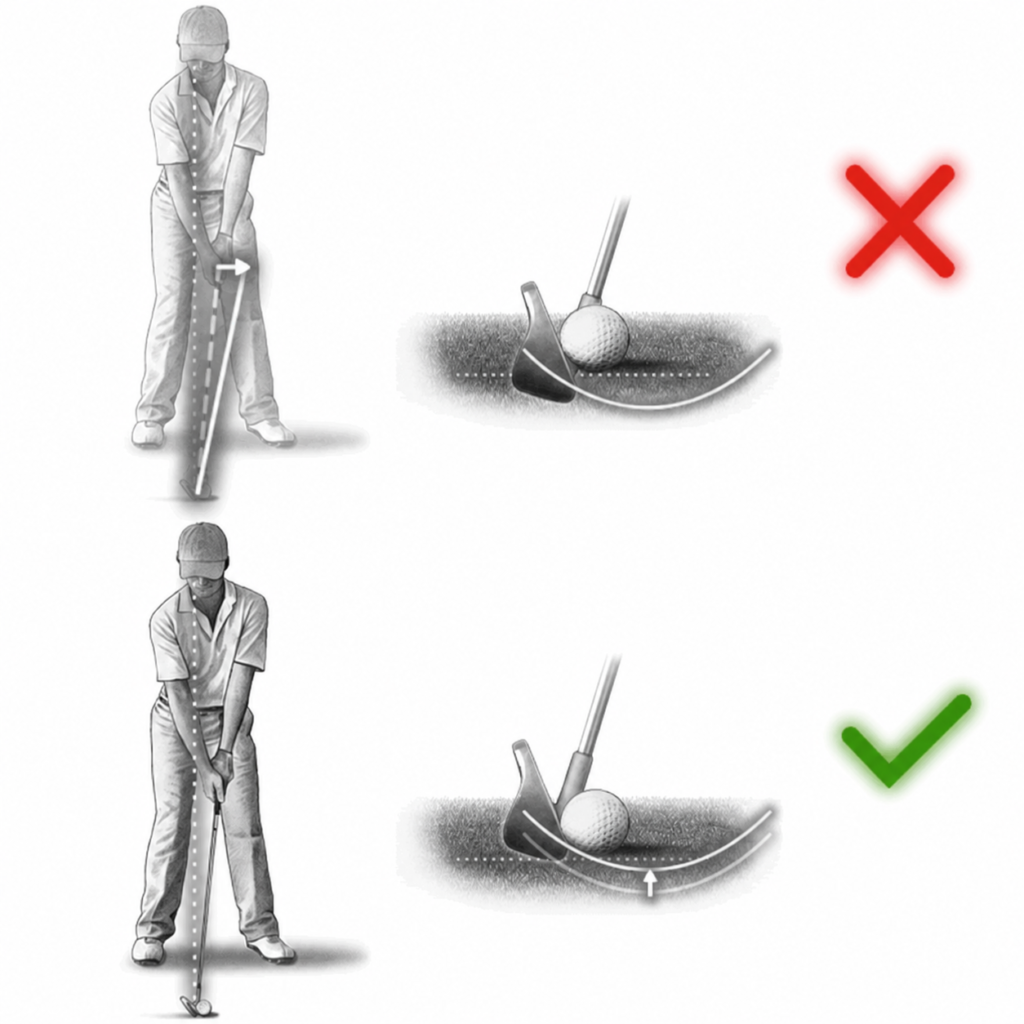
If you hit it thin, you are often trying to help the ball into the air by lifting. Trust the loft of the club. Let the club swing down and through, and the loft does the launching for you.
The One Swing Thought Worth Keeping
If you take only one idea from this guide, make it this. Most golfers over swing. They reach for maximum power and lose their balance, their timing, and their contact all at once.
Swinging within yourself, at roughly ninety percent effort, produces straighter and more consistent shots for almost everyone. This is such a reliable truth that we built a whole strategy around it in The 90 Percent Rule. Pair a controlled effort level with a square face and a forward low point, and your ball flight transforms.
Where It All Comes Together
Everything above happens at impact, but impact is set up by what came before it. A rushed, off balance start to the swing makes a clean strike almost impossible, no matter how good your intentions are on the way down.
This is why diagnosing faults matters so much more than collecting cues. When you know that a slice is a face problem and a fat shot is a low point problem, you stop guessing and start fixing the right thing. For a wider look at the specific faults that hold most recreational golfers back, read through the seven swing mistakes that are quietly destroying your game alongside this guide.
The Bottom Line
Stop collecting random golf swing tips and start reading your ball flight. A slice and a hook are face problems. Fat and thin are low point problems. Fix those two things, keep your effort controlled, and you will do more for your game in a month than a decade of scattered advice ever managed.
When your strike is clean, the next lever is decision making. Learn how to protect a good swing with smart choices in The 90 Percent Rule.